Telescopes gather a signal that eyes alone cannot resolve.
LEONIS COMICS / THE ASTRONOMY EDUCATION PACK
LEONIS:
THE SKY
AWAITS.
Explore • Observe • Question • Discover
Real stars. Extraordinary questions. An illustrated field guide for the next generation of sky scientists.
Free • Grades 6–12 • 14-page mini-magazine • No signup required

OBSERVED SCIENCETESTABLE MODELSLEONIS IMAGINATION
Story artwork inspires the questions. It does not depict confirmed worlds or scientific observations.
01
A lion drawn in light.
Meet Leo
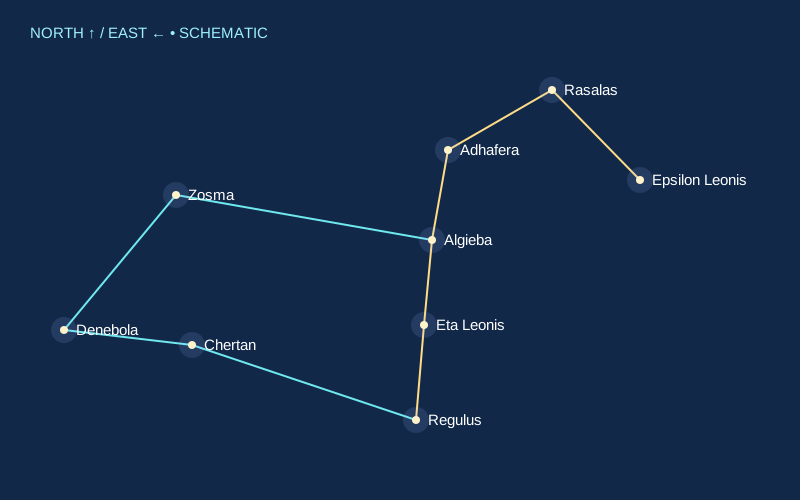
Leo is one of the 88 officially recognized regions of the sky. Its familiar lion outline is a pattern seen from Earth. The Sickle, a smaller pattern called an asterism, looks like a backward question mark. Regulus sits at its base; Denebola marks the tail.
In northern mid-latitudes, look for Leo on spring evenings. Start with a sky chart set to your location, date, and time, then look for the Sickle and the triangle at the lion's rear. From southern locations the pattern may look rotated. In some seasons or locations Leo is below the horizon or too close to the Sun to see at night.
YOUR NEXT QUESTION
Why might two classmates draw different outlines around exactly the same stars?
Constellation: a defined sky region. Asterism: a recognizable star pattern. Horizon: where sky appears to meet the ground.
Sources: NASA: Celestial Wonders in Leo · IAU: The Constellations
02
A star with a spin story.
Regulus: The Lion's Heart
Regulus appears blue-white and lies about 79 light-years away. The bright primary is a hot B-type main-sequence star in a multiple-star system. It turns in roughly 16 hours. That fast rotation makes it wider at its equator than at its poles.
Evidence points to a past exchange of material with a companion. The incoming material also carried angular momentum, which can spin a star up. This is a scientific explanation supported by observations, not something astronomers watched happen in real time. Spectroscopy separates light into wavelengths; spectral lines help reveal composition and motion. Interferometry combines telescope light to resolve very small details.
Line patterns and shifts reveal composition and motion.
Compare predicted spectra and shapes with observations.
YOUR NEXT QUESTION
What evidence would distinguish a rapidly rotating star from a slowly rotating one?
Spectrum: light separated by wavelength. Angular momentum: a quantity describing rotation. Main sequence: the stage of core hydrogen fusion.
Sources: Jim Kaler, University of Illinois: Regulus · AAS / Gies et al.: A Companion for Regulus
03
One direction. Many depths.
The Universe Inside Leo
Leo I is a dwarf spheroidal galaxy associated with the Milky Way. It appears in the direction of Leo, far beyond the stars that trace the lion. A galaxy is a physical system of stars and other matter held together by gravity; a constellation is an address on our sky.
A 2021 study inferred a massive central black hole in Leo I from stellar motions and models. This is a useful case study in indirect evidence, not a photograph of the black hole. A black hole has a boundary called an event horizon beyond which light cannot escape. Astronomers test explanations by comparing predictions with measurements.
COSMIC SCALE EXPLORER
A nearby star in the Milky Way.
Four discrete distance landmarks, not a linear ruler or simulated journey.
YOUR NEXT QUESTION
If a foreground star and a galaxy overlap in a photograph, what extra measurement could separate them in depth?
Galaxy: a gravitationally bound system. Event horizon: a black hole's escape boundary. Model: a testable representation of a system.
Sources: NASA: Celestial Wonders in Leo · McDonald Observatory: Leo I black-hole research (2021) · NASA: Black Holes
04
A star returns its ingredients.
CW Leonis
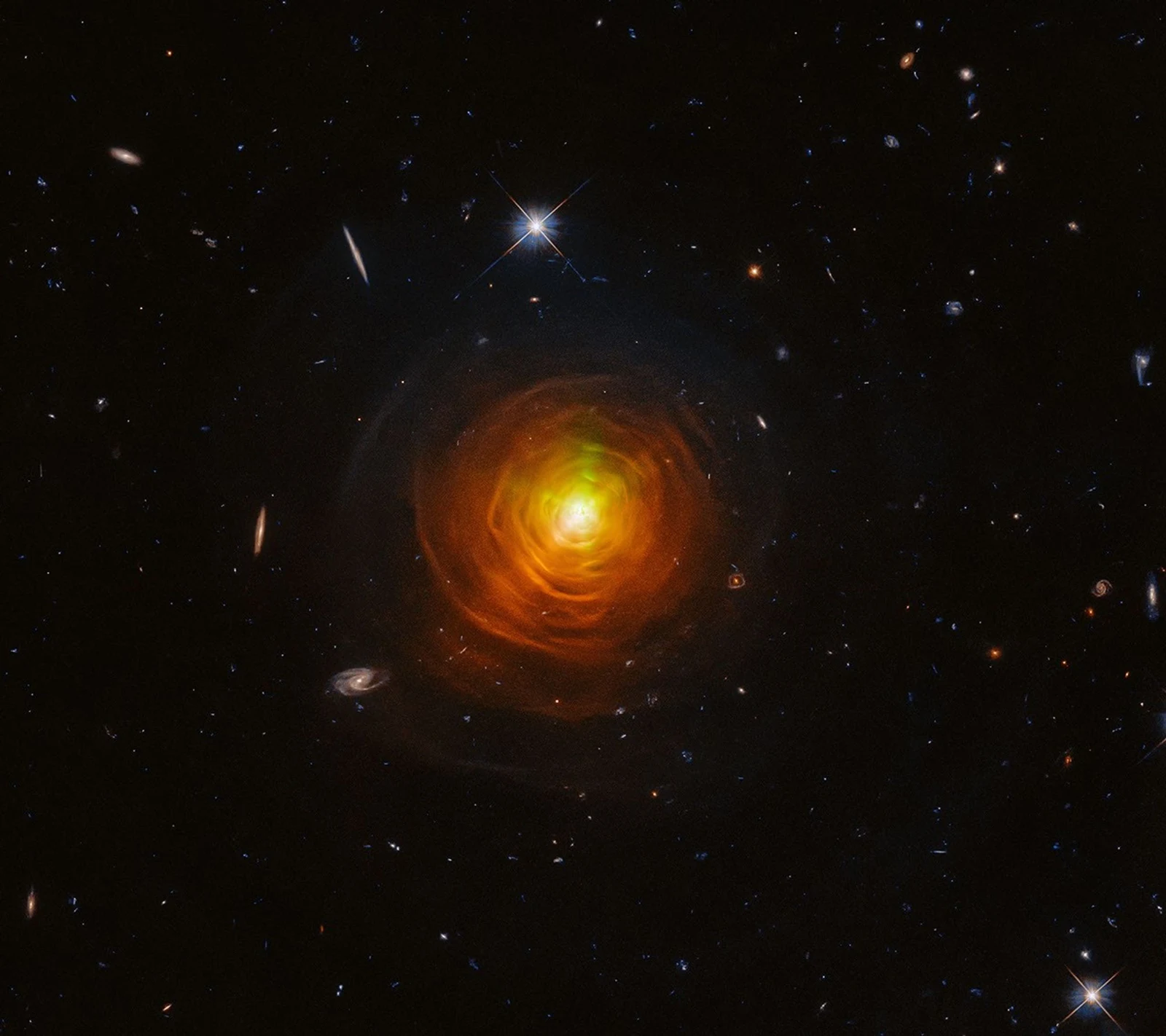
About 400 light-years away, CW Leonis is a dying, carbon-rich red giant wrapped in material it has expelled. Carbon made inside stars can enter interstellar space and become part of later generations of stars and planets. Carbon is central to all known life on Earth; carbon-rich dust is not evidence that life is present around this star.
Hubble reveals shells, arcs, and beams of light in this environment. Comparing images taken years apart helps researchers study change. The picture combines filtered observations with assigned colors, including an infrared channel. It does not show exactly what unaided human eyes would see.
YOUR NEXT QUESTION
List two features you can see in the Hubble image, then write one explanation you would need more evidence to test.
Red giant: an expanded late-life star. Carbon: element 6. Infrared: light with wavelengths longer than visible red.
Sources: NASA / ESA Hubble: CW Leonis
05
Comet dust. Earth's atmosphere. A flash.
The Leonids
The Leonids occur when Earth encounters debris from comet 55P/Tempel–Tuttle. A comet is an icy body that can release gas and dust as it warms near the Sun. A meteor is the streak of light produced as a small piece of space material enters the atmosphere. A meteorite is material that reaches the ground.
Leonid paths appear to spread from a radiant in Leo because of perspective, like parallel railway tracks seeming to meet in the distance. The meteors are nearby atmospheric events, not stars leaving Leo. The shower returns each November; darkness, clouds, moonlight, and debris density affect how many you see.
YOUR NEXT QUESTION
With an adult or club, observe for two equal 10-minute intervals. Record meteors, clouds, and where you looked. Does a zero count prove there was no shower?
Radiant: the apparent origin of a meteor shower. Comet: an icy Solar System body. Meteor: an atmospheric light streak.
Sources: NASA: Leonids Meteor Shower · NASA: 55P/Tempel–Tuttle
06
Can you map Leo from your location?
Become a Sky Scientist
You do not need a telescope to begin. Choose a safe observing spot with an adult or organized group. Use a location-and-time sky chart, a pencil, and a dim light. Never look at the Sun through binoculars or a telescope. If conditions are poor, record that result or use a clearly labeled simulated sky.
Record what you actually see, including uncertainty. Compare a second session at the same time on another night. Use a town or general area rather than your home address. If you share a photo, ask permission before including other people and remove precise location data.
Your field journal
Keep a record in this browser or download a text copy. Nothing here is sent to Leonis. Avoid exact addresses and personal details.
Saved notes remain on this browser until cleared. Clear them on a shared classroom device. Photos are not uploaded.
YOUR NEXT QUESTION
Keep the viewing time and place similar. Change only one condition when possible. What could explain a different star count?
Observation: a recorded measurement or description. Light pollution: artificial light that brightens the night sky.
Sources: NASA: Celestial Wonders in Leo
07
Turn curiosity into evidence.
Challenge Lab
Try the questions before opening the answer key. A strong answer explains why, names evidence, and admits what remains unknown.
Think like an astronomer: How could you tell whether an image is true-color or assigned-color? Why doesn't the brightest-looking star have to be the nearest? What would you need to measure before claiming that a fictional Leonis planet could host liquid water?
Test your sky knowledge
Choose one answer for each question, then check your reasoning.
YOUR NEXT QUESTION
Write a claim, one piece of evidence, and a reason connecting the two.
Evidence: observations used to evaluate a claim. Inference: an explanation drawn from evidence.
Sources: IAU: The Constellations · NASA / ESA Hubble: CW Leonis
08
Build a 3-D model of Leo.
Club / Classroom Challenge
Start with the three-star distance scaffold below, then build the full lion by researching the remaining stars on the map. Work in teams of three or four: a data researcher, model builder, and evidence presenter. Use a cardboard base, ruler, paper stars, string, and tape. Keep all stars the same physical size so size is not confused with brightness.
Choose a scale, calculate each Earth-to-star distance in your model, and place each star along its own sightline from one marked viewing point. Look from that point, then move to the side. Explain how the pattern changes. A model may compress angles for practicality; label every simplification and uncertainty.
Turn the pattern sideways.
This three-star starter uses rounded Earth distances. Sideways rotation reveals the depth that a flat drawing hides. Extend the model to the Sickle and Chertan using researched distances.
Front view of the three-star classroom model.
Illustrative classroom projection, not a navigation chart. Sightline angles are schematic; distances are rounded. The front view uses perspective; the side view shows actual model depth.
| Star | Distance (ly) | Color / type | Model distance (cm) |
|---|---|---|---|
| Regulus | 79 | Blue-white B-type main-sequence primary | 15.8 |
| Denebola | 36 | White A-type main-sequence star | 7.2 |
| Zosma | 58 | White A-type main-sequence star | 11.6 |
Teacher / club facilitation guide
Plan two 45–60 minute sessions, plus optional supervised observing. Begin with the three supplied stars, then assign teams Eta Leonis, Algieba, Adhafera, Rasalas, Epsilon Leonis, and Chertan. Record source, distance, spectral type, apparent magnitude, and uncertainty before expanding the model.
Ask: does a smaller magnitude number mean a brighter or fainter appearance? Compare color and type, but do not use color as a distance meter. Present a front view, a side view, and limitations. See the PDF for construction instructions, answer key, and a 10-point assessment rubric.
YOUR NEXT QUESTION
Present two views, a labeled scale, a source table, and an explanation of why Leo is not a physical lion-shaped star cluster.
Scale: the relationship between model and real measurements. Parallax: apparent position change viewed from different locations.
Sources: IAU: The Constellations · IAU astroEDU: What Is a Constellation? · Jim Kaler, University of Illinois: Denebola · Jim Kaler, University of Illinois: Zosma
FROM REAL QUESTIONS TO IMAGINED WORLDS
The next discovery
starts with you.
Take the field guide outside, bring it to your classroom, or explore the fiction that inspired it.
School and club inquiries: leoniscomics@gmail.com
© 2026 Grow Forward Publishing Company. Leonis Comics and LEONIUS: Throne of the Stars are brand identifiers of the publisher. Leonis artwork and story worlds remain the property of their respective rights holders. Third-party science imagery is credited separately. This independent education pack is not endorsed by NASA, ESA, or the IAU.
LEONIS Education Video Library
Explore real astronomy with these independent creators. Select Play to connect to YouTube.
Every Cosmic Radiation Type Explained
Creator: Supernova
Watch on YouTube ↗Timelapse of the Universe: 13 Billion Years in 10 Minutes • Updated and Remastered
Creator: melodysheep
Watch on YouTube ↗The Sounds of Space: A sonic adventure to other worlds
Creator: melodysheep
Watch on YouTube ↗The Constellations – Leo
Creator: Delta Planetarium
Watch on YouTube ↗Every Type of Nebula Explained
Creator: Space Jason
Watch on YouTube ↗Constellation Close-up: Leo
Creator: Cernan Earth and Space Center
Watch on YouTube ↗Creator credit does not imply endorsement. Videos remain on YouTube and its privacy terms apply when loaded.